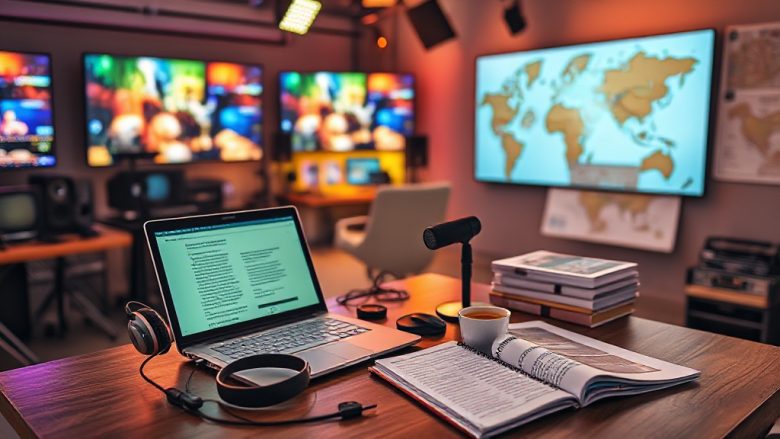
It’s a Tuesday afternoon in late 2026, and a writer sits at a kitchen table with two windows open on her laptop. One is a chatbot that has just produced four variations of a breakup scene she didn’t ask for. The other is a podcast script due by six. She reads the chatbot’s version, deletes three of the four, keeps a single line, and goes back to writing the scene herself. Later that week, she’ll record a serialized audio episode of her own novel and check the climate data in her opening chapter for the third time. This is what a working writing life looks like now, and it’s not the apocalypse or the utopia the headlines promised.
Three creative writing trends to watch in 2026 are doing real work on how writers draft, publish and think about their material: AI-assisted drafting, serialized audio fiction, and climate fiction. Each one has a genuine craft dimension and a career dimension. This piece separates the signal from the noise, trend by trend.
AI-assisted drafting: the co-writer that never sleeps
What it is
AI-assisted drafting means using large language models at specific points in the writing process rather than as a replacement for it. In practice, most writers use these tools for three things: generating alternatives when a scene stalls, compressing research into usable notes, and producing rough scaffolding for structure. The key phrase is at specific points. The writers getting value from these tools aren’t asking a chatbot to write a chapter. They’re asking it to show them five ways a character might react to bad news, then choosing none of them and writing a sixth.
What’s changed in 2026 is the texture of the output. Earlier models produced prose with a distinct synthetic sheen: over-explained emotions, tidy metaphors, a fondness for the word “tapestry.” Current tools are better at mimicking voice, which sounds like good news and is actually the problem. When the machine can sound like you, the temptation to let it finish your sentences grows.
Why it matters
For mid-career writers, the professional risk isn’t replacement. It’s atrophy. Drafting is where a writer finds their ideas, and outsourcing the first pass can quietly hollow out the part of the process that generates original thinking. There’s also a contractual reality: more publishers and magazines now ask about AI use in submissions, and the answers aren’t always comfortable to give. Some literary agents have started requesting disclosure at the query stage, not because they ban the tools but because they want to know what they’re representing.
The upside is real, though. Writers who struggle with executive function, or who work full-time jobs and write in ninety-minute windows, can use these tools to get to a draft faster and spend their best energy on revision. Revision is where most writing actually improves, and anything that buys more revision time is worth considering.
How to prepare
Set a personal policy now, before you need one. Decide which parts of your process are off-limits and write it down. Many writers keep drafting, dialogue and endings entirely human, and use AI only for research summarization, title brainstorming or checking continuity across a long manuscript. That’s a defensible line.
Keep a simple log of what you used and where. If a publisher asks, you’ll have an answer that shows judgment rather than panic. And read your own work aloud regularly. If a paragraph sounds like something you’d never say, that’s a signal worth investigating, whether it came from a model or from a tired version of you at 1 a.m.
Serialized audio fiction: the return of the episode
What it is
Serialized audio fiction is narrative prose written or adapted for listening in installments, usually fifteen to forty minutes each, released on a schedule. It’s not a audiobook, and it’s not a podcast interview show. Think of it as the nineteenth-century serial novel rebuilt for earbuds: cliffhangers, recurring characters, a rhythm designed for commutes and dog walks.
The format has been growing quietly for a few years, and in 2026 it has enough of an audience to support mid-list writers, not just breakout names. Platforms range from dedicated fiction apps to general podcast feeds, and a surprising amount of it is produced by writers who narrate their own work. The production bar is lower than people assume. A decent microphone, a quiet room and free editing software will get you to a listenable episode.
Why it matters
Audio serialization changes how you write, not just how you publish. Listeners can’t skim. They can’t flip back a page to check a name. That forces clarity in dialogue, stronger vocal distinction between characters, and a scene structure that lands meaning through sound. Writers who try it often report that their prose tightens, because every sentence has to survive being read aloud.
It’s also one of the few remaining formats where a writer can build an audience directly, without waiting for a gatekeeper. A serialized story that finds two thousand regular listeners is a meaningful career asset. It’s a proof of audience that agents and publishers understand, and it gives you something to point to that isn’t a stack of rejections.
How to prepare
Start with a story that has natural episode breaks, not a novel you’ve chopped into pieces. Mystery, family saga, workplace drama and speculative fiction all serialize well because they run on questions. Write the first three episodes before you release the first one, so you’re never publishing from an empty tank.
Read every draft aloud during revision. You’ll hear the sentences that don’t work. Keep a character sheet with speech habits, not just descriptions, because listeners identify people by how they talk. And be honest about your voice: if narration drains you, consider a collaborator or a text-to-speech tool used with disclosure, rather than forcing a performance you dread each week.
Climate fiction: from warning to lived experience
What it is
Climate fiction, often shortened to cli-fi, is fiction in which environmental change shapes the world characters inhabit. The genre has moved well past the disaster-novel phase. The interesting work in 2026 is quieter: stories set in places that have already changed, where weather is background rather than plot, and where characters make ordinary decisions inside extraordinary constraints.
You’ll find it across literary fiction, romance, crime and young adult writing. It’s less a genre than a condition that more stories now share, in the same way that smartphones became part of contemporary fiction without anyone declaring a movement.
Why it matters
Readers are living through these changes, and fiction that engages with them honestly earns attention. But there’s a craft trap. Climate fiction fails when it becomes a lecture with characters attached. The best examples keep the human problem central and let the environment apply pressure rather than deliver a message. A farmer negotiating a water allotment with a neighbour is a story. A paragraph explaining the water cycle is not.
For writers, this trend also opens doors. Literary magazines, prizes and reading series have added climate-focused categories and issues, which means more places to publish work that engages with the subject. Editors are actively looking for it, and they’re tired of submissions that read like position papers.
How to prepare
Research locally. The specific detail of a changed river, a new crop, a shifted season in a place you know will outperform any generic global scenario. Talk to people who work outdoors, in agriculture, insurance, local government or emergency services. Their practical knowledge gives you texture that no amount of reading can supply.
Then resist the urge to explain. Let a character be annoyed about the heat rather than have them summarize the climate. Trust readers to connect the dots. If you’re new to the subject, read widely in the field before you write, and consider a short story before a novel. A twelve-page piece will teach you more about handling the material than three years of planning.
What this means for the next few years
None of these trends requires a dramatic reinvention. They ask for small, deliberate adjustments: a written policy on AI use, a willingness to read your own work aloud, a habit of grounding stories in specific places. The writers who navigate the next few years well won’t be the ones who chase every new format. They’ll be the ones who keep their craft central and treat tools and platforms as what they are: choices, made on purpose, in service of the work.
If you do one thing this month, pick one of these three and test it on a small scale. A single serialized episode. One scene drafted with a chatbot and revised without it. One story set somewhere you know that has already changed. The signal is in the doing, not the reading about it.